




" height="10.49577525426244px" id="PijceXWtO" width="98.83298693034646px"/><path d="M 0 0 L 6.616 0 L 6.616 10.067 L 0 10.067 Z" fill="rgb(24, 104, 255)" height="10.067476058515862px" id="OhIEKli0W" transform="translate(100.962 0.288)" width="6.61576998131045px"/><path d="M 0 0 L 6.903 0 L 6.903 10.067 L 0 10.067 Z" fill="rgba(24, 104, 255, 0.6)" height="10.067476058515862px" id="OQDe3B1Qu" transform="translate(107.578 0.288)" width="6.903412154410944px"/><path d="M 0 0 L 6.616 0 L 6.616 10.067 L 0 10.067 Z" fill="rgba(24, 104, 255, 0.4)" height="10.067476058515862px" id="vHC8oR_cM" transform="translate(114.482 0.288)" width="6.61576998131045px"/><path d="M 121.061 0 L 127.964 0 L 127.964 10.067 L 121.061 10.067 Z M 0 13.519 L 7.766 13.519 L 7.766 23.587 L 0 23.587 Z" fill="rgba(24, 104, 255, 0.2)" height="23.586658263716053px" id="YLBJb3Xvt" transform="translate(0 0.288)" width="127.96423368761407px"/><path d="M 0 0 L 7.479 0 L 7.479 10.067 L 0 10.067 Z" fill="rgba(24, 104, 255, 0.4)" height="10.067476058515858px" id="i_yJ70z3Z" transform="translate(7.766 13.807)" width="7.478696500611818px"/><path d="M 0 0 L 7.766 0 L 7.766 10.067 L 0 10.067 Z" fill="rgba(24, 104, 255, 0.6)" height="10.067476058515858px" id="Oz3bJxftD" transform="translate(15.245 13.807)" width="7.766338673712198px"/><path d="M 0 0 L 7.766 0 L 7.766 10.067 L 0 10.067 Z" fill="rgb(24, 104, 255)" height="10.067476058515858px" id="uzQkggWUK" transform="translate(23.011 13.807)" width="7.766338673712312px"/><path d="M 82.854 10.271 L 82.854 0.81 L 79.015 0.81 L 79.015 0.27 L 87.292 0.27 L 87.292 0.81 L 83.483 0.81 L 83.483 10.271 Z M 73.552 10.241 L 73.552 9.702 L 75.816 9.702 L 75.816 0.81 L 73.552 0.81 L 73.552 0.27 L 78.71 0.27 L 78.71 0.81 L 76.446 0.81 L 76.446 9.702 L 78.71 9.702 L 78.71 10.241 L 73.552 10.241 Z M 72.427 0.27 L 72.427 10.241 L 71.797 10.241 L 71.797 0.705 L 67.808 10.241 L 66.849 10.241 L 62.86 0.705 L 62.86 10.241 L 62.231 10.241 L 62.231 0.27 L 63.385 0.27 L 67.344 9.746 L 71.302 0.27 L 72.427 0.27 Z M 60.73 0.27 L 60.73 10.241 L 60.1 10.241 L 60.1 0.705 L 56.112 10.241 L 55.152 10.241 L 51.164 0.705 L 51.164 10.241 L 50.534 10.241 L 50.534 0.27 L 51.688 0.27 L 55.647 9.746 L 59.605 0.27 L 60.73 0.27 Z M 41.514 6.792 L 41.514 0.27 L 42.144 0.27 L 42.144 6.777 C 42.144 8.966 43.133 9.941 45.352 9.941 C 47.571 9.941 48.561 8.967 48.561 6.777 L 48.561 0.27 L 49.191 0.27 L 49.191 6.792 C 49.191 9.117 48.111 10.481 45.352 10.481 C 42.593 10.481 41.514 9.131 41.514 6.792 Z M 33.165 6.673 C 33.165 8.262 33.81 9.911 36.809 9.911 C 38.968 9.911 39.883 9.192 39.883 7.767 C 39.883 6.462 39.343 5.893 37.798 5.623 L 35.354 5.203 C 33.555 4.888 32.94 4.093 32.94 2.744 C 32.94 1.245 34.095 0 36.509 0 C 38.743 0 40.243 1.14 40.377 3.314 L 39.748 3.314 C 39.643 1.665 38.743 0.54 36.509 0.54 C 34.44 0.54 33.6 1.425 33.6 2.744 C 33.6 3.584 33.885 4.364 35.429 4.618 L 38.008 5.053 C 39.838 5.368 40.542 6.118 40.542 7.647 C 40.542 9.446 39.463 10.451 36.809 10.451 C 33.66 10.451 32.535 8.817 32.535 6.672 L 33.165 6.672 Z M 21.466 10.241 L 21.466 0.27 L 25.214 0.27 C 28.513 0.27 29.787 2.474 29.787 5.233 C 29.787 8.037 28.513 10.241 25.214 10.241 Z M 22.096 9.701 L 25.169 9.701 C 28.183 9.701 29.113 7.872 29.113 5.233 C 29.113 2.609 28.198 0.81 25.169 0.81 L 22.096 0.81 L 22.096 9.702 Z M 14.484 10.241 L 14.484 0.27 L 15.114 0.27 L 15.114 9.701 L 20.647 9.701 L 20.647 10.241 Z M 6.917 5.323 L 6.917 9.701 L 13.394 9.701 L 13.394 10.241 L 6.287 10.241 L 6.287 0.27 L 13.349 0.27 L 13.349 0.81 L 6.917 0.81 L 6.917 4.783 L 12.899 4.783 L 12.899 5.323 Z M 0 10.241 L 0 9.702 L 2.264 9.702 L 2.264 0.81 L 0 0.81 L 0 0.27 L 5.158 0.27 L 5.158 0.81 L 2.894 0.81 L 2.894 9.702 L 5.158 9.702 L 5.158 10.241 L 0 10.241 Z" fill="rgb(0, 0, 0)" height="10.480814228845801px" id="NFUWyw0eN" transform="translate(40.558 13.519)" width="87.29163816662458px"/><path d="M 0 0 L 0.75 0 L 3.494 4.678 L 3.973 5.563 C 4.123 5.278 4.303 4.978 4.468 4.678 L 7.212 0 L 7.932 0 L 4.273 6.073 L 4.273 9.971 L 3.644 9.971 L 3.644 6.073 L 0 0 Z" fill="rgb(0, 0, 0)" height="9.971115930527205px" id="O4weVrx36" transform="translate(32.791 13.807)" width="7.931732923245022px"/></g></svg>)





Institutional Considerations for Lido ST Vaults and Delegated Staking
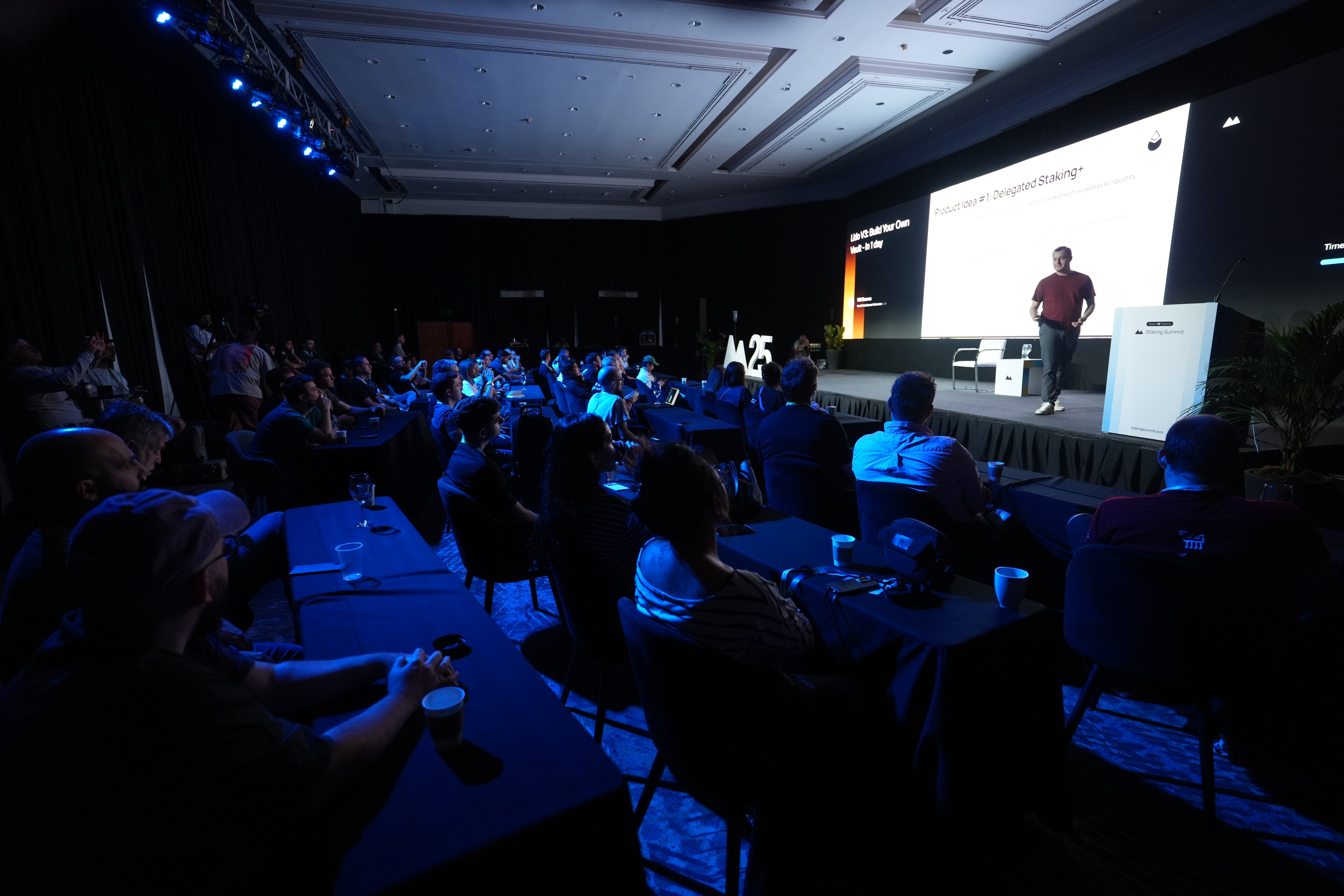
Roughly 70% of staked Ethereum sits locked with no liquidity access. Lido's upcoming ST Vaults aim to change that, letting asset managers select specific node operators while still minting stETH, the market's most liquid staking token with over $150 million in average trading volume. For institutions weighing validator exit queues against redemption obligations, the tradeoff just got more interesting.
🎟️ Digital Asset Yield Summit Series 2026
500+ institutional leaders discussing staking infrastructure, custody, and yield strategies.
• Miami (May 4) • New York (Jun 1) • Singapore (Oct 5-6) • Abu Dhabi (Dec)
Register as Attendee — Use code INSTITUTIONAL for 10% off |
Featuring
Will Shannon - Head of Node Operator Mechanisms, Lido
1) Why 70% of Staked ETH Lacks Liquidity
The math is stark. Native staking locks capital with no secondary market access. Exit queues can stretch to 37 days during periods of high validator churn. For a hedge fund facing redemption windows or an ETF with daily liquidity mandates, that's a non-starter. The Lido protocol, which functions as middleware connecting users to node operators running validators, currently holds over 8.4 million ETH. It's fully governed by the Lido DAO. Yet even with liquid staking tokens available, most institutional ETH holders have stayed on the sidelines, staking natively through direct node operator relationships. Why? Compliance requirements, counterparty preferences, and the desire to select specific infrastructure providers.
The problem is real. As one Lido contributor put it: "The product that most node operators are offering to institutions is incompatible with where institutional staking is going." Source That incompatibility centers on liquidity. Or rather, the lack of it.
2) How ST Vaults Enable Delegated Staking
ST Vaults represent a fundamental shift. They allow node operators, DeFi builders, and asset managers to construct custom staking vaults with optional liquidity. The architecture is non-custodial and permissionless to deploy. When you stake through an ST Vault, ETH flows into validators operated by your chosen node operator. That operator earns rewards. You, as the staker, can then mint stETH against your position if liquidity needs arise.
This is delegated staking with a twist. "Stakers can now choose the node operators that they want to stake with," the presentation noted. Source The existing Lido protocol, recently known as LB2 and now called Lido V4, remains unchanged. Press the stake button on Lido's interface, deposit 100 ETH, receive 100 stETH distributed across the node operator set. ST Vaults run parallel to this. They're additive, not a replacement. The timeline? Approximately 1.5 months until ST Vaults go live.
3) Node Operator Selection Meets stETH Liquidity
Here's where it gets interesting for institutional desks. You can maintain your existing node operator relationships. Solstice, P2P, Chorus One, Everest Stake. These tier-1 operators have already announced plans to integrate ST Vaults. Your compliance team approved them. Your due diligence is done. Now you can route stake to them specifically while gaining access to stETH, which carries over $150 million in average trading volume.
The fee structure matters. For institutions not utilizing liquidity, fees remain very attractive. When you do mint stETH, the cost is roughly 1% of staking rewards. That's the price of avoiding a 37-day exit queue. "An institution would not be stuck in a 37-day exit queue. They just can't. stETH solves that." Source The 1:1 minting ratio holds. Stake 100 ETH, mint up to 100 stETH. When the liquidity need passes, repay the position and continue earning rewards in the vault.
🎟️ Evaluating custody and liquidity frameworks?
Join institutional peers at the Yield Summit Series to discuss staking infrastructure, regulatory considerations, and operational due diligence.
Register as Attendee (code INSTITUTIONAL for 10% off) | Become a Sponsor
4) Non-Custodial Architecture and Regulatory Considerations
The permissionless, non-custodial design creates both opportunity and ambiguity. On one hand, institutions retain control. No intermediary holds your ETH. The smart contract architecture means assets remain on-chain, verifiable, auditable. On the other hand, regulatory classification remains unsettled. Does a non-custodial staking wrapper satisfy qualified custodian requirements? Unclear from the transcript whether Lido has obtained formal guidance on this point.
DAO governance introduces additional considerations. The protocol is "fully governed by the Lido DAO," which means upgrade authority, fee changes, and emergency response capabilities sit with token holders, not a centralized entity. For institutions requiring SLAs and defined escalation paths, this governance model warrants scrutiny. What's the multisig composition? Who can pause contracts? These questions belong in your diligence checklist. The target client segments span hedge funds, ETFs, family offices, and digital asset treasuries. Each carries distinct compliance needs. The architecture appears flexible enough to accommodate permissioned deployments, but validation is required.
5) DeFi Rapper's Low-Code Institutional Toolkit
ST Vaults handle the staking infrastructure. DeFi Rapper handles the product layer. It's a no-code and low-code kit launching alongside ST Vaults that enables builders to deploy end-user staking products. Features include pooling for multi-depositor vaults, white-label embeddable UI components, and custom ERC20 vault tokens. The claim is aggressive: "You can have an end-user-ready product in 24 hours." Source
Pre-built strategies come curated by Veda and Mellow. Future capabilities include integrated looping strategies for leverage staking. That last point deserves a red flag. Leverage staking introduces recursive exposure and liquidation risk. Collateralization ratios, margin call procedures, and liquidation mechanics require independent assessment before any institutional deployment. The white-label capability also raises disclosure questions. If end clients interact with a branded product that obscures Lido protocol dependency, what are your transparency obligations? The customer relationship stays with you as the node operator or asset manager. But protocol risk doesn't disappear just because the branding does.
For institutions evaluating ST Vaults, the value proposition is clear: maintain node operator selection, gain liquidity optionality, access deep DeFi integrations. The risks are equally clear: DAO governance uncertainty, smart contract dependencies across multiple protocols, and regulatory ambiguity around custody classification. Lido's concentration, with 8.4 million ETH representing significant market share, also warrants monitoring for systemic risk implications. The product launches soon. The diligence starts now.
How to Position as an Allocator (Bank, Treasury, Fund)
Before deploying capital, get your internal framework sorted. ST Vaults offer real flexibility, but that flexibility means more decisions land on your desk. Here's how to think through it.
Define mandate fit first. Can your fund tolerate principal loss from smart contract failure or slashing? If not, staking exposure probably doesn't belong in your risk budget. Full stop.
Pick the right product tier. Vanilla delegated staking through a tier-1 operator like P2P or Chorus One sits at one end. Leveraged vault strategies curated by Veda or Mellow sit at the other. Know which you're buying.
Resolve the custody question. The non-custodial architecture is elegant, but does it satisfy your qualified custodian requirements? Legal needs to weigh in before treasury commits.
Build monitoring and controls. DAO governance means no SLA. You'll want on-chain alerting for governance proposals, fee changes, and contract upgrades. Consider third-party monitoring tools.
Nail down reporting and audit trails. stETH positions, minting events, reward accruals. All of it needs to flow into your existing reporting stack. Test this on testnet before mainnet.
Start with a pilot. Small allocation, limited duration, clear success metrics. Define your stop conditions upfront: what drawdown or operational failure triggers an exit?
Scale only after validation. Pilot worked? Great. Now stress-test stETH liquidity assumptions under adverse scenarios before increasing exposure.
🎟️ Continue the conversation at Digital Asset Yield Summit Series 2026
• Miami (May 4) • New York (Jun 1) • Singapore (Oct 5-6) • Abu Dhabi (Dec)
Register as Attendee - Use code INSTITUTIONAL for 10% off |
Glossary
Validator Exit Queue
The protocol-enforced waiting period to withdraw staked ETH from Ethereum's consensus layer. During periods of high withdrawal demand (validator churn), this queue can extend to 37 days as the network rate-limits exits to maintain stability.
Why it matters: Exit queue duration directly impacts liquidity risk modeling - funds with redemption windows shorter than potential queue times face a structural mismatch that ST Vaults are designed to address.
Liquid Staking Token (LST)
A tokenized claim on staked assets that can be traded or used in DeFi while the underlying ETH remains locked in validators. stETH is the LST referenced throughout this article, issued by the Lido protocol.
Why it matters: LST liquidity depth determines whether you can actually exit a position at scale without significant slippage - the $150 million average trading volume cited for stETH is the relevant benchmark for sizing decisions.
Delegated Staking
A staking arrangement where the asset owner selects a specific node operator to run validators on their behalf, rather than having stake distributed automatically across an operator set. Used here to mean the ST Vault model where institutions route ETH to pre-approved operators.
Why it matters: Delegated staking preserves existing compliance approvals and counterparty relationships, reducing the due diligence burden when adding liquidity optionality via ST Vaults.
Qualified Custodian
A regulated entity (bank, broker-dealer, or futures commission merchant) that meets specific SEC or state requirements to hold client assets. Investment advisers managing over $150 million typically must use qualified custodians under the Custody Rule.
Why it matters: Non-custodial smart contract architectures may not satisfy qualified custodian requirements - legal review is essential before treasury deployment to avoid regulatory exposure.
Multisig
A smart contract wallet requiring multiple private key signatures (e.g., 3-of-5) to authorize transactions. DAOs commonly use multisigs for emergency functions like pausing contracts or executing time-sensitive upgrades.
Why it matters: Multisig composition determines who can unilaterally affect your staked assets - understanding signer identities, geographic distribution, and key management practices belongs in operational due diligence.
Slashing
A penalty mechanism where validators lose a portion of staked ETH for protocol violations such as double-signing or extended downtime. Slashing events result in permanent principal loss to stakers.
Why it matters: Slashing risk flows through to your position regardless of the liquidity wrapper - node operator track record, infrastructure redundancy, and insurance coverage are key controls to evaluate.
Looping Strategies
Recursive leverage techniques where staked assets are used as collateral to borrow, which is then re-staked, repeating the cycle to amplify yield. The article references these as future DeFi Rapper capabilities.
Why it matters: Looping introduces liquidation risk and margin call exposure that compounds during market stress - collateralization ratios and liquidation mechanics require independent assessment before any allocation.
DAO Governance
A decentralized decision-making structure where protocol changes are proposed and voted on by token holders rather than a centralized management team. The Lido DAO governs fee structures, operator onboarding, and contract upgrades.
Why it matters: DAO governance means no SLAs, no defined escalation paths, and upgrade authority distributed across anonymous token holders - institutions need on-chain monitoring for governance proposals that could affect positions.
Middleware
Software that sits between end users and underlying infrastructure, abstracting complexity. Used here to describe Lido's role connecting stakers to node operators without users needing to run validators directly.
Why it matters: Middleware introduces an additional smart contract dependency layer - protocol risk at the middleware level affects all downstream positions regardless of which node operator you select.
White-Label
A product or service produced by one company that other companies rebrand and sell as their own. DeFi Rapper's white-label UI allows node operators to offer Lido-powered staking under their own branding.
Why it matters: White-labeling raises disclosure obligations - if end clients don't know they have Lido protocol exposure, you may bear liability for undisclosed smart contract and governance risks.
ERC20 Vault Tokens
Custom tokens following Ethereum's ERC20 standard that represent shares in a specific vault. DeFi Rapper enables operators to issue branded vault tokens representing depositor positions.
Why it matters: Custom vault tokens may have different liquidity profiles than stETH itself - secondary market depth for your specific vault token determines actual exit optionality versus theoretical liquidity access.
Validator Churn
The rate at which validators enter or exit the Ethereum network. High churn periods - when many validators attempt to exit simultaneously - extend queue times as the protocol throttles withdrawals.
Why it matters: Churn rates are unpredictable and can spike during market stress precisely when liquidity is most needed - stress-testing should model adverse churn scenarios, not just average conditions.