




" height="10.49577525426244px" id="PijceXWtO" width="98.83298693034646px"/><path d="M 0 0 L 6.616 0 L 6.616 10.067 L 0 10.067 Z" fill="rgb(24, 104, 255)" height="10.067476058515862px" id="OhIEKli0W" transform="translate(100.962 0.288)" width="6.61576998131045px"/><path d="M 0 0 L 6.903 0 L 6.903 10.067 L 0 10.067 Z" fill="rgba(24, 104, 255, 0.6)" height="10.067476058515862px" id="OQDe3B1Qu" transform="translate(107.578 0.288)" width="6.903412154410944px"/><path d="M 0 0 L 6.616 0 L 6.616 10.067 L 0 10.067 Z" fill="rgba(24, 104, 255, 0.4)" height="10.067476058515862px" id="vHC8oR_cM" transform="translate(114.482 0.288)" width="6.61576998131045px"/><path d="M 121.061 0 L 127.964 0 L 127.964 10.067 L 121.061 10.067 Z M 0 13.519 L 7.766 13.519 L 7.766 23.587 L 0 23.587 Z" fill="rgba(24, 104, 255, 0.2)" height="23.586658263716053px" id="YLBJb3Xvt" transform="translate(0 0.288)" width="127.96423368761407px"/><path d="M 0 0 L 7.479 0 L 7.479 10.067 L 0 10.067 Z" fill="rgba(24, 104, 255, 0.4)" height="10.067476058515858px" id="i_yJ70z3Z" transform="translate(7.766 13.807)" width="7.478696500611818px"/><path d="M 0 0 L 7.766 0 L 7.766 10.067 L 0 10.067 Z" fill="rgba(24, 104, 255, 0.6)" height="10.067476058515858px" id="Oz3bJxftD" transform="translate(15.245 13.807)" width="7.766338673712198px"/><path d="M 0 0 L 7.766 0 L 7.766 10.067 L 0 10.067 Z" fill="rgb(24, 104, 255)" height="10.067476058515858px" id="uzQkggWUK" transform="translate(23.011 13.807)" width="7.766338673712312px"/><path d="M 82.854 10.271 L 82.854 0.81 L 79.015 0.81 L 79.015 0.27 L 87.292 0.27 L 87.292 0.81 L 83.483 0.81 L 83.483 10.271 Z M 73.552 10.241 L 73.552 9.702 L 75.816 9.702 L 75.816 0.81 L 73.552 0.81 L 73.552 0.27 L 78.71 0.27 L 78.71 0.81 L 76.446 0.81 L 76.446 9.702 L 78.71 9.702 L 78.71 10.241 L 73.552 10.241 Z M 72.427 0.27 L 72.427 10.241 L 71.797 10.241 L 71.797 0.705 L 67.808 10.241 L 66.849 10.241 L 62.86 0.705 L 62.86 10.241 L 62.231 10.241 L 62.231 0.27 L 63.385 0.27 L 67.344 9.746 L 71.302 0.27 L 72.427 0.27 Z M 60.73 0.27 L 60.73 10.241 L 60.1 10.241 L 60.1 0.705 L 56.112 10.241 L 55.152 10.241 L 51.164 0.705 L 51.164 10.241 L 50.534 10.241 L 50.534 0.27 L 51.688 0.27 L 55.647 9.746 L 59.605 0.27 L 60.73 0.27 Z M 41.514 6.792 L 41.514 0.27 L 42.144 0.27 L 42.144 6.777 C 42.144 8.966 43.133 9.941 45.352 9.941 C 47.571 9.941 48.561 8.967 48.561 6.777 L 48.561 0.27 L 49.191 0.27 L 49.191 6.792 C 49.191 9.117 48.111 10.481 45.352 10.481 C 42.593 10.481 41.514 9.131 41.514 6.792 Z M 33.165 6.673 C 33.165 8.262 33.81 9.911 36.809 9.911 C 38.968 9.911 39.883 9.192 39.883 7.767 C 39.883 6.462 39.343 5.893 37.798 5.623 L 35.354 5.203 C 33.555 4.888 32.94 4.093 32.94 2.744 C 32.94 1.245 34.095 0 36.509 0 C 38.743 0 40.243 1.14 40.377 3.314 L 39.748 3.314 C 39.643 1.665 38.743 0.54 36.509 0.54 C 34.44 0.54 33.6 1.425 33.6 2.744 C 33.6 3.584 33.885 4.364 35.429 4.618 L 38.008 5.053 C 39.838 5.368 40.542 6.118 40.542 7.647 C 40.542 9.446 39.463 10.451 36.809 10.451 C 33.66 10.451 32.535 8.817 32.535 6.672 L 33.165 6.672 Z M 21.466 10.241 L 21.466 0.27 L 25.214 0.27 C 28.513 0.27 29.787 2.474 29.787 5.233 C 29.787 8.037 28.513 10.241 25.214 10.241 Z M 22.096 9.701 L 25.169 9.701 C 28.183 9.701 29.113 7.872 29.113 5.233 C 29.113 2.609 28.198 0.81 25.169 0.81 L 22.096 0.81 L 22.096 9.702 Z M 14.484 10.241 L 14.484 0.27 L 15.114 0.27 L 15.114 9.701 L 20.647 9.701 L 20.647 10.241 Z M 6.917 5.323 L 6.917 9.701 L 13.394 9.701 L 13.394 10.241 L 6.287 10.241 L 6.287 0.27 L 13.349 0.27 L 13.349 0.81 L 6.917 0.81 L 6.917 4.783 L 12.899 4.783 L 12.899 5.323 Z M 0 10.241 L 0 9.702 L 2.264 9.702 L 2.264 0.81 L 0 0.81 L 0 0.27 L 5.158 0.27 L 5.158 0.81 L 2.894 0.81 L 2.894 9.702 L 5.158 9.702 L 5.158 10.241 L 0 10.241 Z" fill="rgb(0, 0, 0)" height="10.480814228845801px" id="NFUWyw0eN" transform="translate(40.558 13.519)" width="87.29163816662458px"/><path d="M 0 0 L 0.75 0 L 3.494 4.678 L 3.973 5.563 C 4.123 5.278 4.303 4.978 4.468 4.678 L 7.212 0 L 7.932 0 L 4.273 6.073 L 4.273 9.971 L 3.644 9.971 L 3.644 6.073 L 0 0 Z" fill="rgb(0, 0, 0)" height="9.971115930527205px" id="O4weVrx36" transform="translate(32.791 13.807)" width="7.931732923245022px"/></g></svg>)





A Holistic DeFi Risk Assessment Framework for Institutions
A protocol with a reputable audit, investor backing, and frequent industry recommendations just lost $93 million anyway. The culprit wasn't a smart contract bug. It was an external manager who lost everything, a risk dimension that code audits simply don't touch. For institutions evaluating on-chain yield, this failure exposes an uncomfortable truth: single-factor due diligence, no matter how rigorous, misses at least seven other dimensions where principal can vanish.
🎟️ Join 500+ institutional leaders at the Digital Asset Yield Summit Series
• Miami (May 4) • New York (Jun 1) • Singapore (Oct 5-6) • Abu Dhabi (Dec)
Register as Attendee - Use code INSTITUTIONAL for 10% off
Featuring
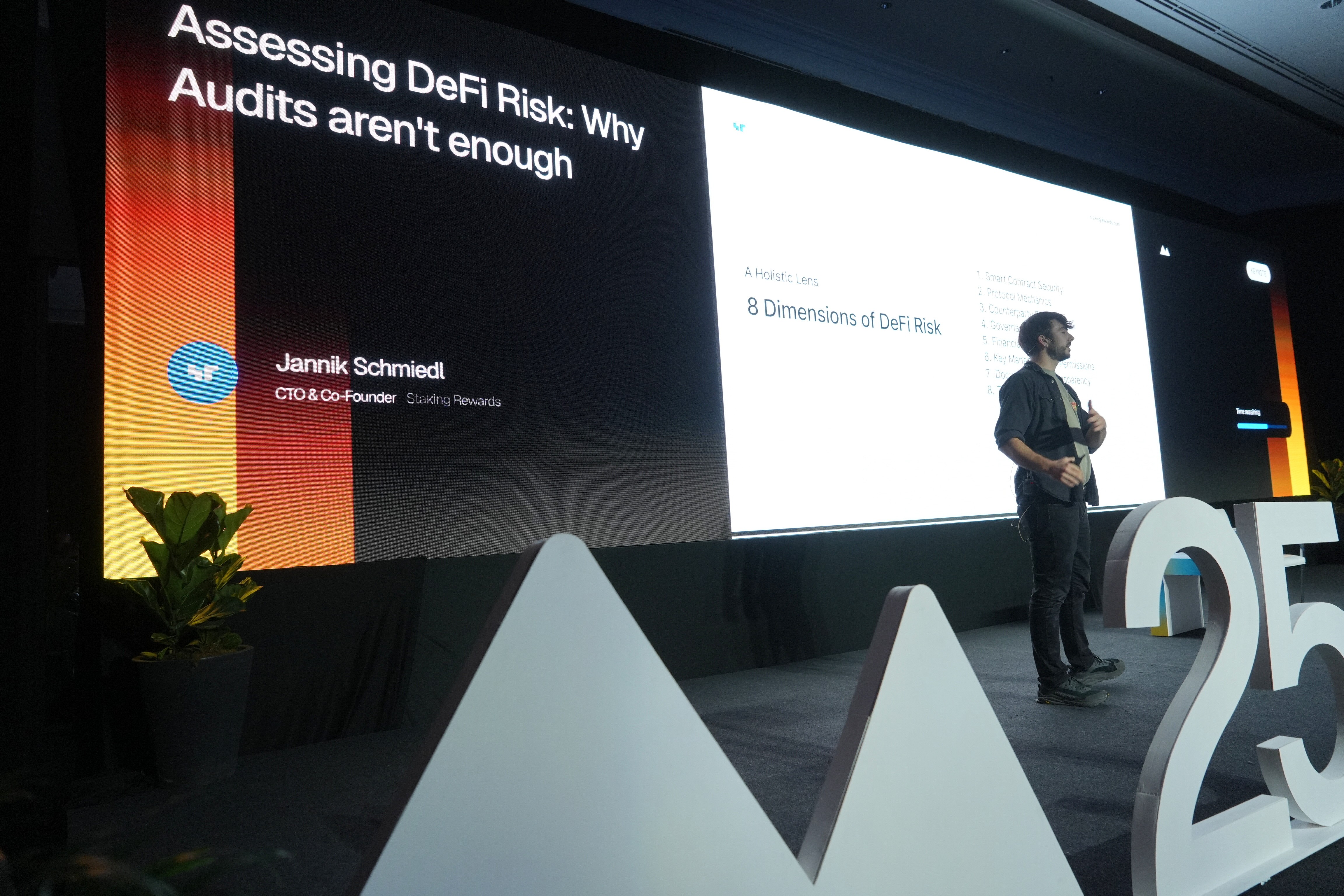
Jannik Schmiedl - CTO & Co-Founder, Staking Rewards
Why Audits Alone Miss Critical Risks
Stream protocol was audited by Zenit, described as a "very reputable auditing firm." The team looked legitimate. Investors had backed them. Industry participants recommended them frequently. And yet, $93 million evaporated. Here's the uncomfortable reality: "Many protocols that have been exploited, they had audits. They had many audits." Source
Audits verify code at a point in time. They don't verify operational controls, counterparty arrangements, or governance structures. Relying on audit status alone is, as one analyst put it, "like evaluating a jet engine by the paint job." Smart contracts should be open source, independently audited, and re-audited after protocol upgrades. But that's table stakes, not the whole picture.
External Manager Exposure: The Hidden Threat
Stream didn't fail because of an unaudited code path. It failed because real people ran opaque leverage strategies through brittle structures. The protocol had delegated funds to an external manager. Then came the message: "They had an external manager and they said oopsie, all the funds have been lost." Source
This is counterparty risk in its purest form. No smart contract vulnerability required. Institutions must ask: what percentage of TVL depends on external protocols or managers? What contractual recourse exists? If the answer is unclear, that's a red flag. Delegation without transparency creates unmonitored credit and operational risk that can result in total loss.
Stablecoin Depeg Contagion Across DeFi
Stream's collapse didn't stay contained. XUSD depegged, "ripping back across the whole industry." Source A single protocol failure triggered cascading effects across multiple asset classes and venues. This is systemic risk, DeFi-style.
For institutional portfolios, stablecoin concentration limits matter. Real-time depeg monitoring with automated position reduction triggers isn't optional anymore. Exposure to one stablecoin failure can propagate losses far beyond the initial allocation. The interconnectedness of DeFi means your risk isn't isolated to what you hold directly.
Governance and Key Management Blind Spots
Code audits won't tell you who controls the keys. They won't reveal multisig distribution or signing rights. "This is what a code audit will not show you. They will not show how is the multisig distributed, like who has signing rights." Source
Admin key compromise or malicious governance action can drain funds regardless of smart contract soundness. Institutions need to mandate disclosure of multisig configurations, timelocks, and admin key custody arrangements before any allocation. Who can change the rules? Who can move the funds? Who can pause the protocol or drain it completely? These questions require answers, not assumptions.
🎟️ Yield Summit Series 2026
Where institutional allocators discuss DeFi risk frameworks, custody, and due diligence standards.
Register as Attendee (code INSTITUTIONAL for 10% off)
TVL and Yield as Lagging Indicators
High TVL and attractive yields feel reassuring. They shouldn't. "Protocol metrics, they're good, but they showcase state. They showcase public sentiment and this is certainly not a risk control." Source
Stream looked better than half the DeFi market by conventional metrics. Still a house of cards. TVL reflects where capital has gone, not where it should go. Yield reflects current conditions, not structural resilience. Supplement these metrics with stress testing and scenario analysis. Ask what happens to liquidity and yield sustainability under adverse market conditions.
Transparency Gaps Signal Operational Risk
One of the more telling details from Stream's website: they had a menu item labeled "transparency." Click on it and you'd find "transparency coming soon." Source That's not a minor oversight. That's a red flag.
Documentation and transparency form a distinct risk dimension. What proof of reserves exists? Are they documented? Do they match protocol TVL? Lack of transparency impedes auditability, regulatory reporting, and incident response. Institutions should establish minimum transparency standards as a gating criterion. If a protocol dismisses these basics, something is very wrong.
Continuous Re-Assessment After Protocol Upgrades
An audit is a snapshot. Protocols evolve. "They should be open source, they should be independently audited, they should be repeated after protocol upgrades." Source A protocol that was safe at onboarding may become unsafe post-upgrade without re-certification.
Institutions need ongoing monitoring for protocol upgrades. What's the upgrade process? How are changes communicated to depositors? Is there a commitment to re-audit after material changes? Without continuous re-assessment, your initial due diligence decays in value with every code change.
Building a Multi-Dimensional Risk Framework
Assessing DeFi risk requires a systemic and unbiased view. "We have to have eight dimensions that we have to look at and assess." Source Those dimensions: smart contract security, protocol mechanics, counterparty exposures, governance control, strategy construction, financial resilience mechanics, key management and permissions, and documentation and transparency.
Each dimension interacts with the others. Robust contracts mean little if protocol mechanics create fragile liquidity. Strong governance means nothing if an external manager can lose everything. It's a combination problem. Siloed checks miss emergent risks from dimension interactions. Staking Rewards is currently developing a DeFi risk rating framework to apply this eight-dimension assessment systematically. For institutions, the path forward is clear: move from "is it audited?" to "where can it break?" That shift in framing changes everything.
Investor backing and industry recommendations are not reliable proxies for protocol safety. Social proof doesn't substitute for independent risk analysis. Can users withdraw permissionlessly under stress? Do verifiable insurance funds meaningfully cover liabilities? Is there a real, accountable team with a solid jurisdictional setup? These questions demand evidence, on-chain and off-chain. Most decisions in this space are currently driven by FOMO. That's not a friend in crisis situations.
How to Position as an Allocator (Bank, Treasury, Fund)
Before deploying capital, get honest about what you can actually stomach. Stream had audits, investor backing, industry recommendations. Still lost $93 million. Your positioning framework needs to account for the fact that DeFi risk is a combination problem, not a checklist.
Define your principal loss tolerance upfront. If total loss of allocation breaks your mandate or triggers regulatory issues, structured DeFi with external manager exposure is probably not for you.
Match product type to risk budget. Vanilla staking typically carries different risk profiles than stablecoin yield strategies or leveraged DeFi. Know what you're buying.
Require full disclosure on custody, multisig configurations, and key management. Code audits won't show you who controls the funds or what they can do with them.
Build reporting and auditability into your governance process. If a protocol's transparency page says "coming soon," that's your answer. Walk away.
Implement continuous monitoring for protocol upgrades and counterparty changes. An audit is a snapshot. Protocols evolve. Your diligence should too.
Start with a pilot allocation and define explicit stop conditions. Scale only after you've verified withdrawal mechanics under stress and validated on-chain proof of reserves.
🎟️ Continue the conversation at the Digital Asset Yield Summit Series 2026
• Miami (May 4) • New York (Jun 1) • Singapore (Oct 5-6) • Abu Dhabi (Dec)
Register as Attendee — Use code INSTITUTIONAL for 10% off
Glossary
TVL (Total Value Locked)
The aggregate dollar value of assets deposited in a DeFi protocol at a given time. Used here as a measure of protocol adoption and capital concentration.
Why it matters: High TVL is often mistaken for safety, but it reflects past capital flows - not structural soundness - and can mask underlying fragility until a stress event occurs.
Multisig (Multi-Signature Wallet)
A wallet configuration requiring multiple private key holders to approve a transaction before it executes. Common configurations include 3-of-5 or 4-of-7 signing thresholds.
Why it matters: Multisig distribution determines who can move or drain protocol funds; without disclosure of signers and thresholds, allocators cannot assess key-person or collusion risk.
Depeg
When a stablecoin's market price diverges materially from its intended peg (typically $1.00). Used here to describe XUSD losing its dollar parity following Stream's collapse.
Why it matters: Depeg events can cascade across portfolios and protocols, turning isolated exposure into systemic loss - requiring real-time monitoring and automated position reduction triggers.
Timelocks
Smart contract mechanisms that enforce a mandatory delay between when a governance or admin action is proposed and when it can be executed.
Why it matters: Timelocks give depositors a window to exit before adverse changes take effect; absence of timelocks means admin actions can drain or alter a protocol instantly.
Proof of Reserves
Verifiable on-chain or auditor-attested evidence that a protocol's claimed assets actually exist and match reported liabilities or TVL.
Why it matters: Without proof of reserves, allocators cannot confirm solvency or detect misappropriation until losses have already occurred.
Permissionless Withdrawal
The ability for users to redeem their deposited assets directly via smart contract without requiring approval from protocol operators or third parties.
Why it matters: If withdrawals require human approval or can be paused by admins, liquidity risk escalates sharply during stress events when exit demand spikes.
Protocol Upgrade
Any change to a protocol's deployed smart contract code, parameters, or logic - whether through proxy contracts, governance votes, or admin keys.
Why it matters: Upgrades can introduce new vulnerabilities or alter risk profiles, rendering prior audits obsolete and requiring continuous re-assessment.
Admin Key
A privileged private key (or set of keys) with elevated permissions to modify protocol parameters, pause operations, or move funds outside normal user flows.
Why it matters: Compromise or misuse of admin keys can result in total loss regardless of smart contract soundness - making custody arrangements a critical due diligence item.
Counterparty Exposure
Risk arising from dependence on external parties - such as external managers, custodians, or integrated protocols - whose failure or misconduct can cause loss.
Why it matters: Stream's $93 million loss originated from an external manager, not a code bug; counterparty exposure must be mapped and monitored separately from smart contract risk.
Financial Resilience Mechanics
Protocol-level safeguards designed to absorb losses or maintain solvency under stress, such as insurance funds, reserve pools, or liquidation buffers.
Why it matters: Allocators need to verify whether these mechanisms are adequately funded and whether coverage meaningfully matches potential liabilities.
Vanilla Staking
Basic proof-of-stake participation where tokens are locked to secure a network in exchange for protocol-issued rewards, without additional leverage or yield strategies layered on top.
Why it matters: Vanilla staking typically carries a narrower risk profile than structured DeFi products, making it a more appropriate starting point for conservative allocators.
On-Chain Evidence
Data recorded immutably on a public blockchain - such as transaction histories, contract states, or reserve balances - that can be independently verified without relying on protocol disclosures.
Why it matters: On-chain evidence provides auditable, tamper-resistant confirmation of claims; its absence forces reliance on off-chain attestations that may be incomplete or falsified.